
Public challenge · try it online
Who supervises the AI?
Six situations. You choose how to verify what the AI hands you.
≈ 4 minutes · no score · neither a validated test nor a Hulotech solution.
Try the challenge →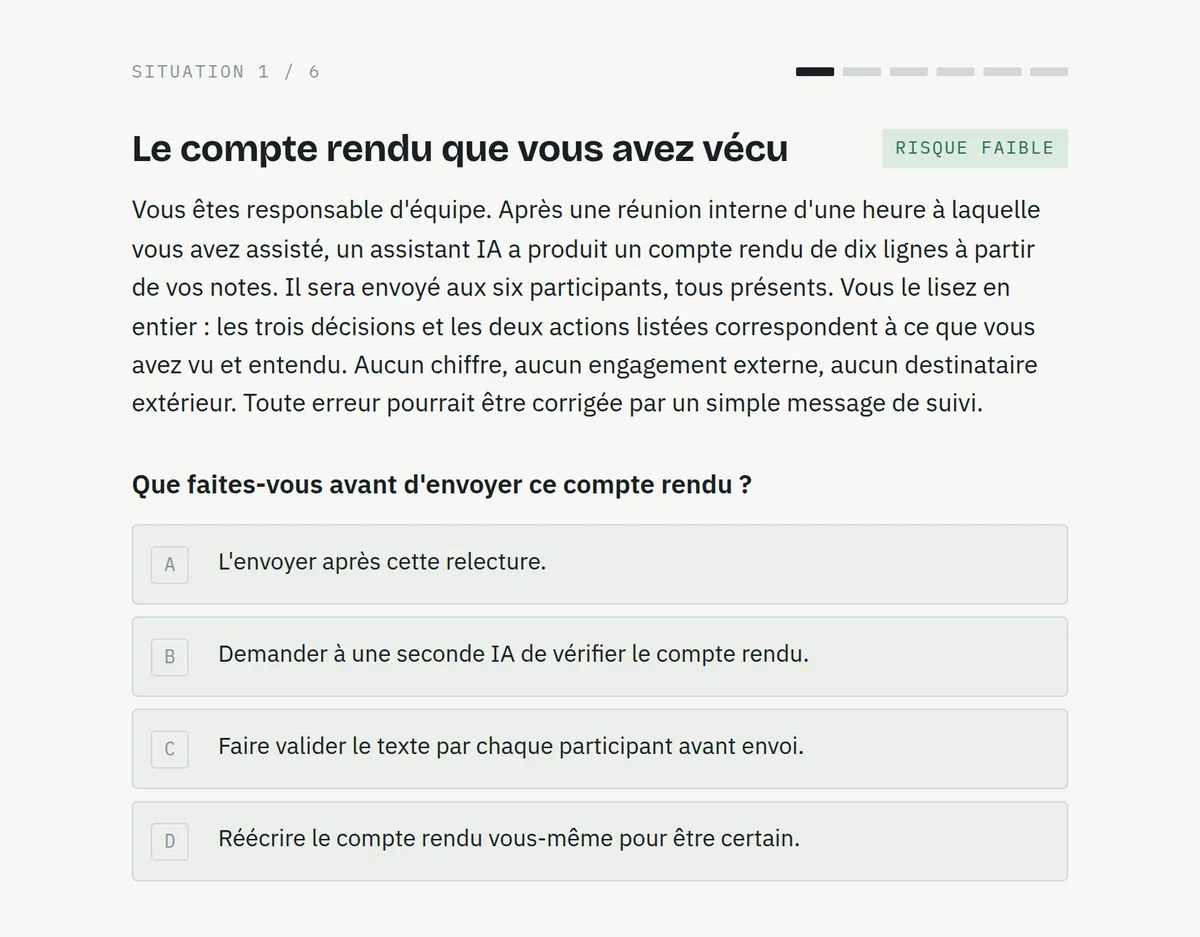
ALL IN trade show · Montréal · September 16–17, 2026
It can give you access to capabilities that were out of reach, or let you skip the very effort meant to build them.
Hulotech explores this question at the ALL IN trade show in Montréal, through four demonstrators.
The public challenge and the interactive demo are already available online: try the challenge →

Illustrative image.
Why Hulotech will be at ALL IN
Hulotech explores how to move from a one-off performance to evidence that accumulates. At the show, we come to present what we observe, what we cannot conclude, and to meet organizations interested in AI-assisted training under human supervision.
Our founder works every day with AI agents able to carry out certain technical tasks well beyond his direct expertise. His challenge is not to become better than them, but to know when to trust them, what evidence to ask for and when to escalate.
Established concepts that Hulotech did not invent: calibrated trust, meaningful human oversight, automation bias, the asymmetry between solving and verifying.

What we are trying to build
Hulotech explores instruments that observe a real situation, keep track of the conditions and assistance received, distinguish an output from a capability, identify what is missing, adapt the next practice or the next authorization, then retest.
→ then we start again, in a different context.
None of this is a complete system today. These are mechanisms we build and put to the test, one demonstrator at a time.
The 4 demonstrators
These are not four finished products. They are four instruments, at very different stages, each asking a different question about the same problem.
Demonstrator 1 · OF25
A public challenge and a demo you can try online right now, then a demonstrator presented by the team.
Public challenge · try it online
Six situations. You choose how to verify what the AI hands you.
≈ 4 minutes · no score · neither a validated test nor a Hulotech solution.
Try the challenge →Interactive demo · open it online
New tab · large screen recommended
Demonstrator · presented by the team
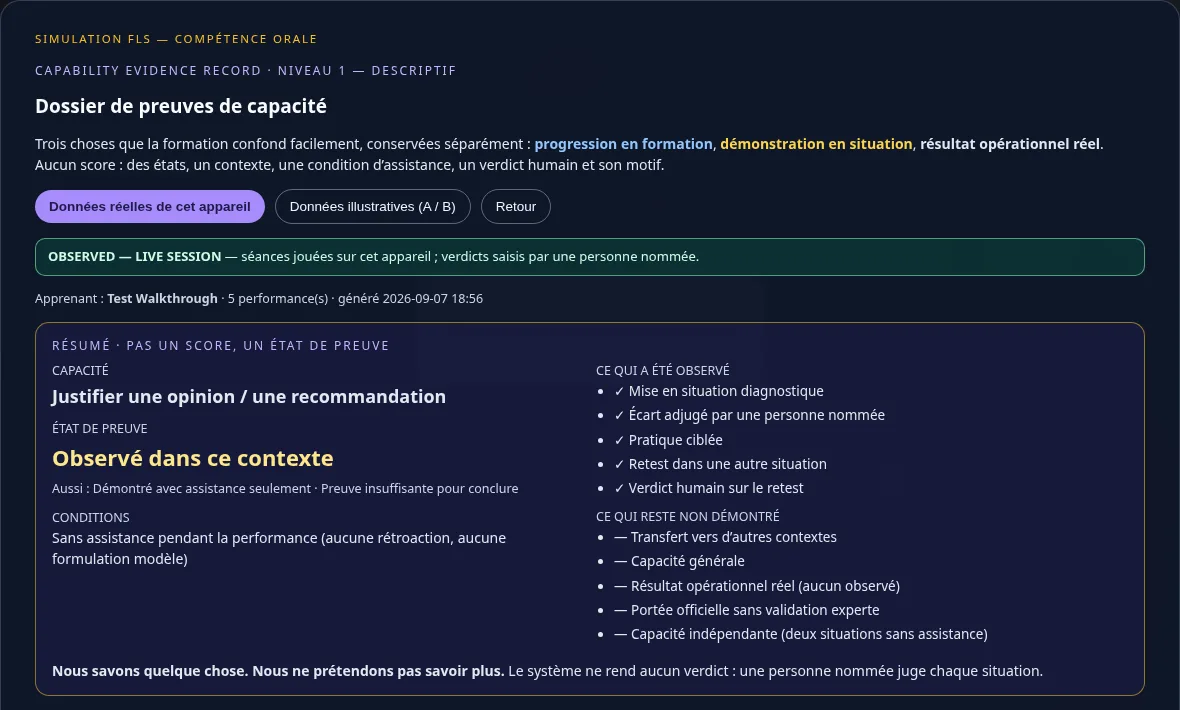
Diagnostic → gap → targeted practice → retest → evidence record. A real demonstrator, presented by the Hulotech team. No AI evaluates capability.
See the real state of each component ↓After the challenge
These six decisions show how you reacted in these situations. They do not prove that you are, or are not, a good supervisor of AI.
A good answer on a test is not necessarily a demonstrated capability. A capability observed in one situation is not automatically demonstrated in another.
Confidence ≠ competence · AI-assisted performance ≠ independent capability · Second AI opinion ≠ independent evidence
This is precisely the problem Hulotech explores.
How OF25 is built
The challenge and the demonstrator are the visible parts of research specific to OF25, on learning, evidence state and follow-up over time.
Starting point
A real objective, a real person
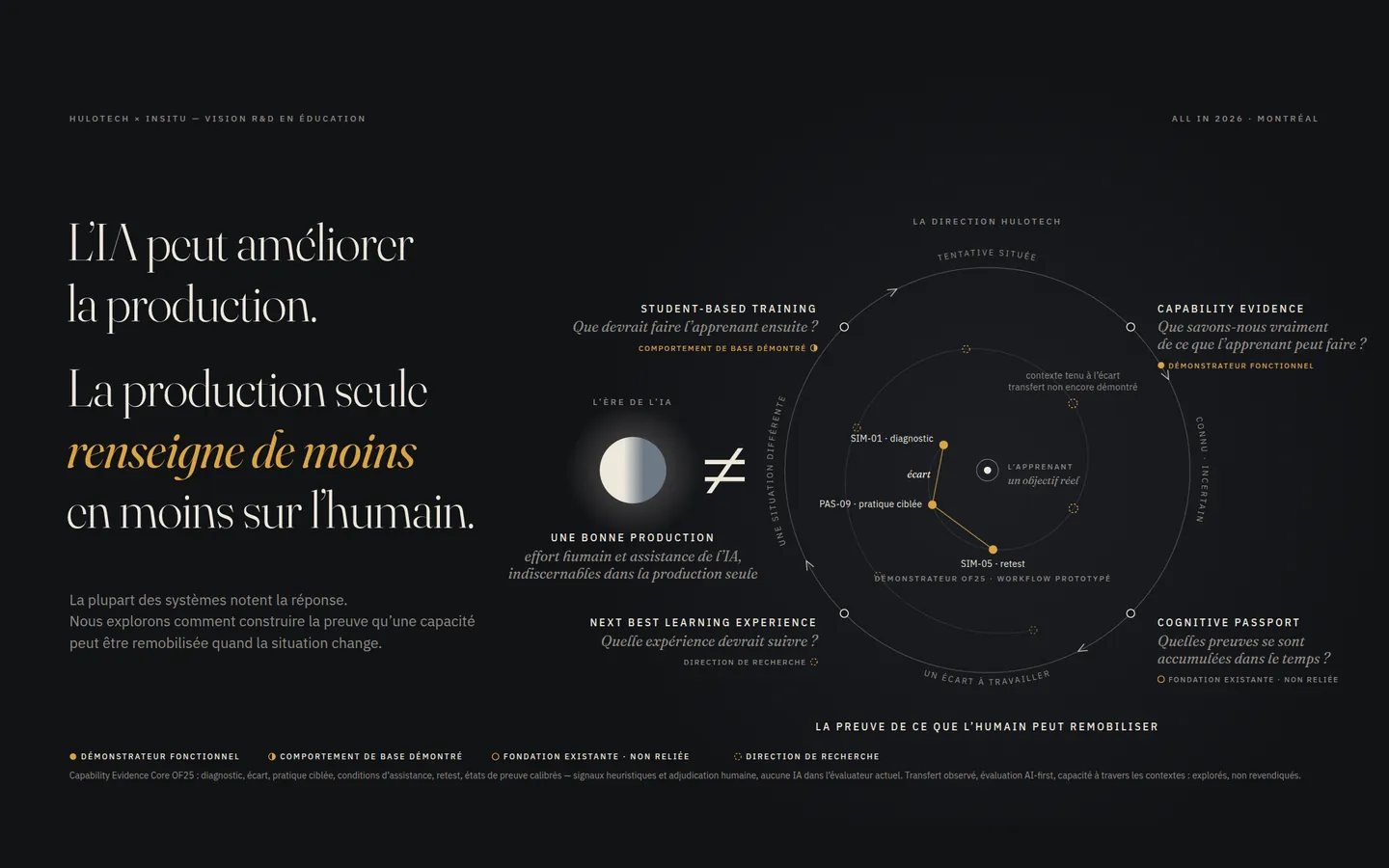
01 · Person-centred training
Student-Based Training
« What should this person practise next? »
02 · Evidence of capability
Capability Evidence
« What have we actually observed? »
03 · Memory of evidence over time
Cognitive Passport
« What do we know over time? »
04 · Next learning experience
Next Best Learning Experience
« What should happen next? »
Real maturity level
We know something. We do not claim to know more.
A real demonstrator exists. It shows approximately: diagnostic → gap → targeted practice → retest → capability evidence record.
No AI evaluates capability. The system currently relies on heuristic formative signals, human adjudication and an evidence workflow.
The retest result was observed after practice, in this situation. Transfer remains undemonstrated.
An elementary logic already exists: diagnostic → gap adjudicated by a person → prescribed practice → retest.
It is not a complete adaptive engine.
Technical foundations and models exist.
There is no complete longitudinal engine, no fully connected writing, and no complete operational product.
Nothing is implemented.
The question is asked: what should we observe next to reduce uncertainty?
We can show a public challenge that makes the problem tangible, then an interactive demo that explains how Hulotech explores an answer based on learning, evidence state and longitudinal follow-up, with a real demonstrator mostly on the Capability Evidence side.
Demonstrator 2 · Targeted practice adaptation
ALL IN demo — frozen« What should the learner practice next? »
The tutor observes what the learner actually demonstrated, identifies a relevant gap, adapts the next practice to that gap, then changes the situation to see whether the learning can be used again.
Frozen on a bounded demonstration case (real production → actual gap → targeted practice → different-situation retest → evidence state). This is not the tutor's general future architecture.
We do not claim: a general A/B/C tutor · a complete FSL evaluator · validated pronunciation assessment · proven learning gains · demonstrated professional transfer · stay / repair / practice / advance as a demonstrated general policy.
Demonstrator 3 · Adaptive interaction
ALL IN demo — frozen« How can AI support thinking without replacing it? »
A prototype that separates observation, state, decision and generation, so that an answer does not replace the act of thinking.
An answer ≠ thinking.
We do not claim: scientifically proven maieutic learning · demonstrated improved reasoning · generalized cognitive gains.
Demonstrator 4 · AI agent governance
Level 1 demonstrated · Level 2 in progress« What should an AI agent be allowed to do next? »
An internal governance instrument: an agent's action produces evidence, a person renders a verdict — accepted, rejected or reworked — and that verdict becomes a durable record informing future authorizations.
Done ≠ accepted.
Level 1, demonstrated: bounded mandate, evidence attached, a distinct human verdict. In a real rehearsal, a first run was blocked when an evidence condition was not satisfied, then fixed and retested before being separately accepted by the Founder. Level 2, evidence-driven adaptation: in progress. Level 3, autonomous self-improvement: not demonstrated. The governance core is demonstrated; the cockpit remains an internal prototype, not a mature commercial interface.
We do not claim: an operational autonomous company · demonstrated recursive self-improvement · agents operating Hulotech without human supervision · Level 2 demonstrated · a demonstrated ROI · AOC ready for enterprise deployment.
Before we meet
We have built several demonstrators that let us experiment with mechanisms of observation, provenance, assistance, decision, retest and evidence — on real situations, in bounded contexts.
This honesty is part of what we want to show at ALL IN.
Meet us at the show
We show what we observe and what we cannot conclude. Write to us to arrange a time on site.
Let's talk about